Color
Qualified name: algan.constants.color.Color
- class Color(rgb, glow=0, opacity=1, *args, **kwargs)[source]
Bases:
TensorA color, as five channels: red, green, blue, glow and opacity.
Everything in Algan that takes a color – a Mob’s
colorandstroke_color, a material’s, a light’s, a Scene’s background – accepts one of these, or anything the constructor below accepts. The named palette (BLUE,RED_E,WHITE, …) is made of them.Glow and opacity are channels rather than separate attributes so they travel with the color through ordinary arithmetic:
BLUE * 0.5dims the color and halves its alpha, and interpolating between two colors interpolates their emissive strength too. When you want to change one channel alone, useset_opacity()or assign toglow.A
Coloris atorch.Tensorsubclass, so it takes part in tensor arithmetic and can carry batch dimensions – a(*, 5)array of them is what paints one color per vertex or per texel.- Parameters:
rgb (str | tuple[float, ...] | list[float] | torch.Tensor | np.ndarray) – The color. Accepts a hex string (
"#58C4DD", with an optional eighth digit for alpha), a CSS color name ("teal"), an(r, g, b)sequence in[0, 1], an(r, g, b, a)or(r, g, b, glow, a)sequence, or a tensor of any of those widths. A four- or five-wide value suppliesopacity(andglow) itself.glow – Additive emissive brightness, fed to the bloom accumulator. Unbounded above;
0is a non-emissive surface. Defaults to0.opacity – Alpha, in
[0, 1]:0invisible,1fully opaque. Defaults to1, except wherergbcarried an alpha of its own.*args – Passed to
torch.Tensor.__new__().**kwargs – Passed to
torch.Tensor.__new__().
- rgb
The first three channels, as a plain tensor. Assignable.
- glow
The fourth channel, shape
(*, 1). Assignable.
- opacity
The fifth channel, shape
(*, 1), in[0, 1]. Assignable.
- Raises:
.InvalidColorError – If a string is neither a hex code nor a known CSS color name.
- Parameters:
rgb (str | tuple[float, ...] | list[float] | torch.Tensor | np.ndarray)
See also
set_opacity()Change the alpha alone, leaving the rest.
add_defaults()Pad a bare RGB or RGBA tensor to five channels.
Examples
Three ways of spelling a color, and a glowing one:
Example: Example1Color 
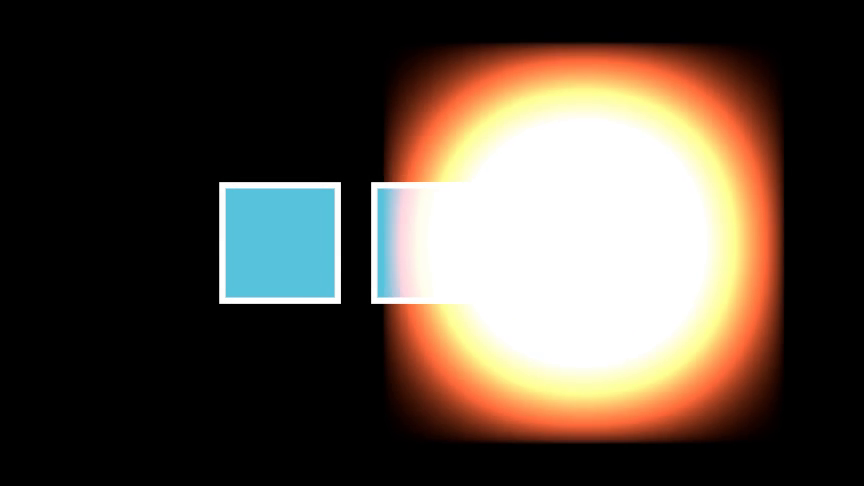
from algan import *

Square(color=BLUE).move(LEFT * 2.5).spawn()
Square(color="#58C4DD").spawn()
Square(color=Color((1, 0.4, 0.2), glow=3)).move(RIGHT * 2.5).spawn()

Scene.save_video()
Methods
Widen RGB or RGBA to Algan's
[R, G, B, glow, opacity].convert_to_uint8is_transparentReturn a copy of this color with its opacity scaled.
mult_rgbReturn a new opaque black
Coloron this color's device.prep_setset_glowReturn a copy of this color with its opacity replaced.
set_rgbAttributes
- static add_defaults(color)[source]
Widen RGB or RGBA to Algan’s
[R, G, B, glow, opacity].Only 3 and 4 channels are widened. A width that is neither is not a color missing its extra channels, and padding it anyway meant the error it eventually caused reported a shape the caller never wrote –
ImageMob(torch.zeros(8, 8, 2))was told its texture had shape(8, 8, 4).
- mult_opacity(opacity)[source]
Return a copy of this color with its opacity scaled.
Reach for this when you want “half as visible as it already is” and for masking a texture, where the factor varies per texel. Use
set_opacity()when you know the alpha you want.Unlike
set_opacity()this does not range-check, for two reasons. A multiply is a transform rather than a setting, so the same reasoning that keepsscale(0)and a negative scale legal applies. And this is on the per-batch render path –get_render_primitivescalls it with texture-sized tensors and with replayed opacity values that an overshooting rate function can carry a hair outside[0, 1]– where an element-wise check would both cost and reject legitimately.- Parameters:
opacity – Factor to multiply the existing alpha by. A tensor is broadcast against this color, giving one factor per row – per vertex or per texel – which is how a mask is applied to a texture.
- Returns:
A new color. The color it was called on is left unchanged, so the named palette constants stay safe to reuse.
- Return type:
See also
set_opacity()Replace the alpha outright, range-checked.
- new_empty(*args, **kwargs)[source]
Return a new opaque black
Coloron this color’s device.Overrides
torch.Tensor.new_empty(), which would otherwise hand back an uninitialized tensor of the requested size: a color’s row is always the fixed[R, G, B, glow, opacity], so the size arguments are accepted for signature compatibility and ignored, and the row is zeroed rather than left as whatever the allocator returned. Keyword arguments are forwarded to theColorconstructor.
- set_opacity(opacity)[source]
Return a copy of this color with its opacity replaced.
Opacity is one of the five channels, so ordinary color arithmetic moves it along with the others –
BLUE * 0.5halves the alpha as well as the brightness, and renders half-transparent. This sets the alpha channel alone and leaves red, green, blue and glow as they are.- Parameters:
opacity – The new opacity, in
[0, 1]: 0 is invisible, 1 fully opaque. A value outside that range raises rather than being clamped. A tensor is broadcast against this color, giving one opacity per row – per vertex or per texel, and every element has to be in range.- Returns:
A new color. The color it was called on is left unchanged, so the named palette constants stay safe to reuse.
- Return type:
- Raises:
AlganConfigurationError – If
opacityis non-finite, or outside[0, 1].
See also
mult_opacity()Scale the existing alpha instead of replacing it.